My Own Path - From the UK to Brazil and back.
How did I get into this ‘samba stuff’? In this post I reflect on where it began for me, plus who I have learned from along the way, how my regular groups came to be and how my work fits in to the context of the ‘samba scene’ in the UK.
Excuse the self-indulgence. If you’re a member of one of my groups I hope it will help you understand who taught your teacher. If you’re interested in getting involved, wherever you’re based, I hope it will help you find your own path through this music.
Beginnings
I have been playing piano since I was around 6 and guitar since I was 13, but my first taste of ‘samba drumming’ was while studying my Bachelors at Warwick Uni in 2007. The SU drumming society received funding from the music department to hire in a local tutor, Dave Barratt, to teach a regular group he called Drumestra. We performed together around campus and locally.
I remember being captivated by all of these ‘new’ rhythms. They weren’t just a simple Rock/Pop backbeat, they were layered and syncopated. They weren’t just to hold a beat to serve a vocal, they were the music.
Then, in 2010-11, while studying for a Masters in Music at Bath Spa, I played with Robbie Verecchia’s Jamma de Samba groups, Bloco Talento and Samba Sulis. Robbie was running Jamma de Samba full-time, offering school, corporate, and community workshops. What a cool job! His business model inspired me to start Olá Samba in Gloucestershire. He was very supportive in helping me get started. Robbie's emphasis on openness, fun, and high-energy performances was exactly what I wanted for my own groups.
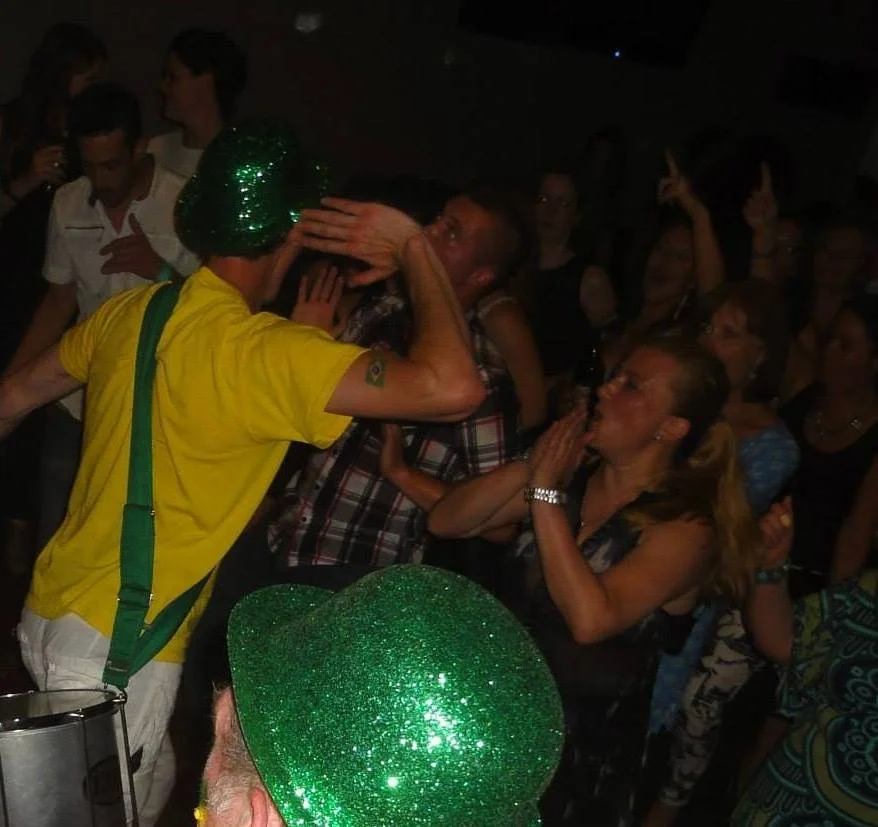
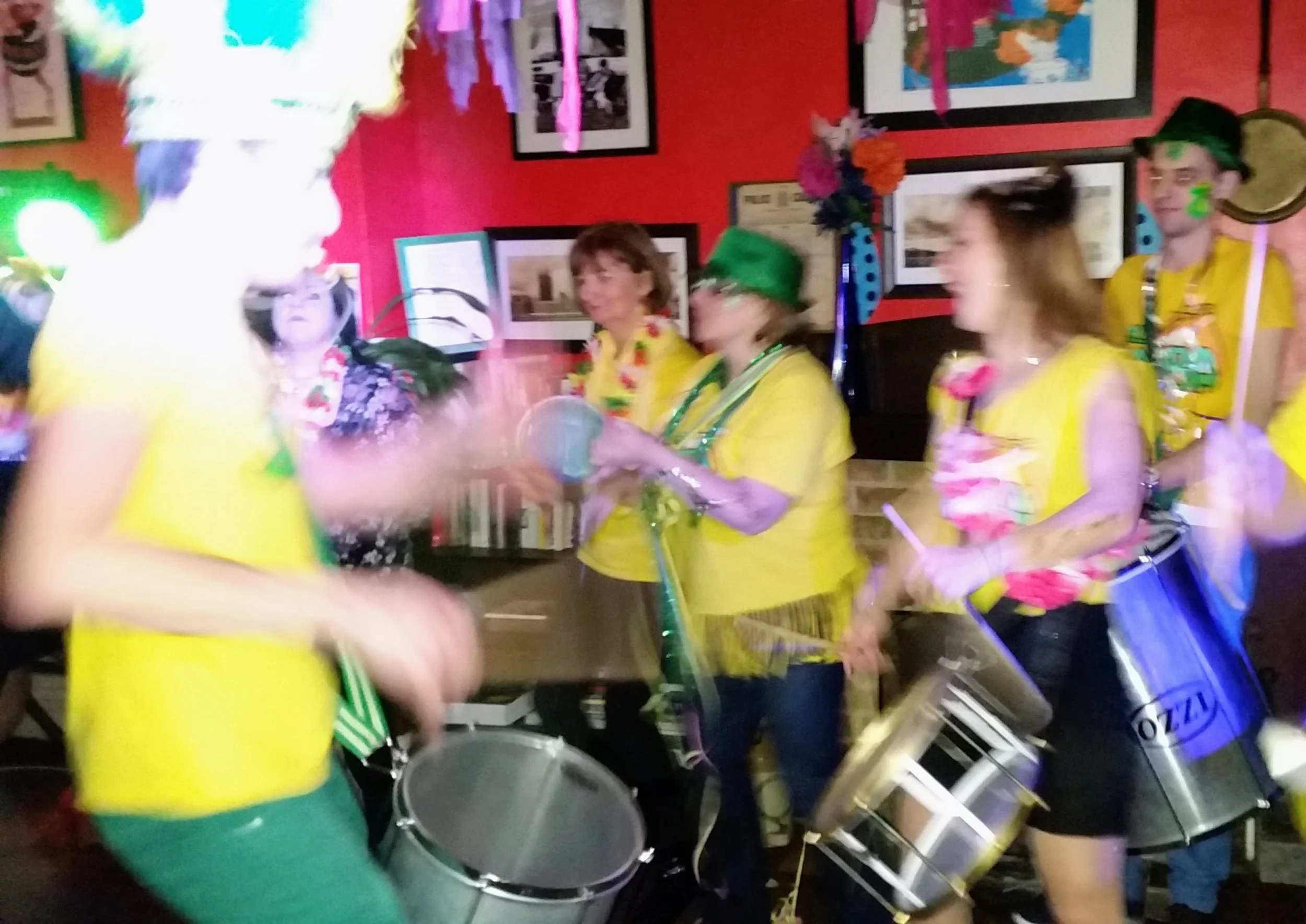
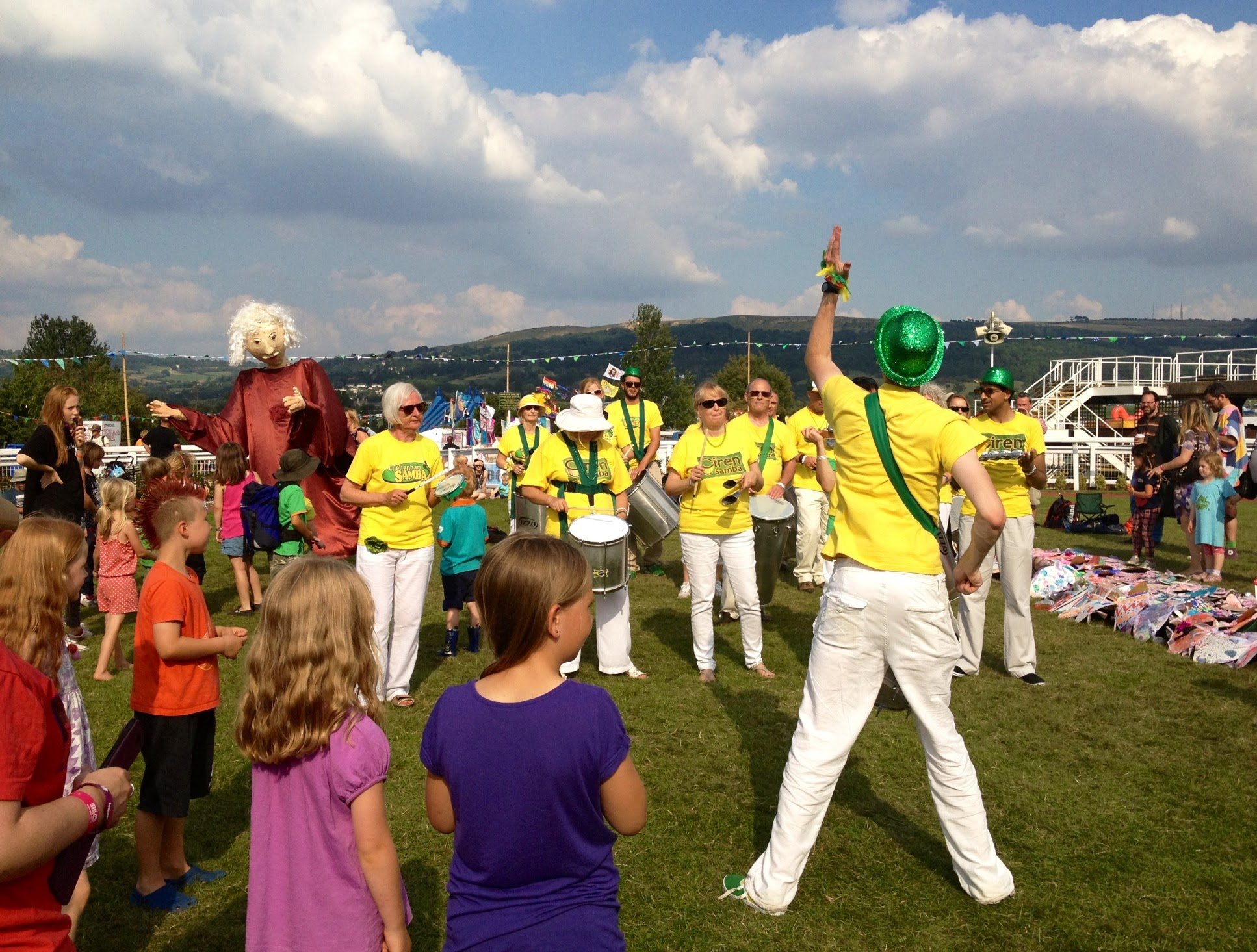
I started teaching professionally in schools under the name Olá Samba in September 2011. I started the community evening class groups Ciren Samba in January 2012 and Cheltenham Samba in April 2013, plus the Silver Sambistas in January 2013.
The name ‘Olá Samba’ popped into my head driving back from a rehearsal with Samba Sulis, and it refused to leave! To me, the name is a simple way to sum up saying ‘hello’ to something new and Brazilian. Everything I do through Olá Samba keeps these two things in mind - introducing people to this ‘new’ thing while acknowledging its roots.
To Brazil
One night at the pub after an early-days Cheltenham Samba rehearsal, Kate F, mentioned a group she played with in Bristol called Ziriguidum, and that they were planning a trip to play in Rio for Carnival 2014. I went to see them play, was very impressed, signed up and studied hard (along with one of my other new group members, Tan) to be ready to join them in Rio.
Ziriguidum joined forces with Nova Guarda and Toque Tambor to form Carnaval Transatlântico (a name which later stuck). We were the first officially registered bloco from the UK to play in the carnaval da rua. We played a range of percussion styles along to Brazilian songs. We performed at some prestigious venues in Lapa, joining Monobloco in performance in the Fundiçao Progresso, opening for Jorge Aragão at Circo Voador and holding our own show under the iconic Lapa arches.
This was a huge trip for the whole group and for me, personally. To be there in the country itself, to glimpse the culture that this music thrives within, put everything in a new light.
Did you know: The word Ziriguidum is onamatopoeic of the swing of a samba
The musical director of Ziriguidum and Carnaval Transatlântico was JP Courtney, who now works under the name JPPercussion and since 2015 runs annual two-week courses to Rio to learn from local mestres and tutors. Tan and I went on the first one of these courses. It was an excellent way to learn from a range of some of the best musicians in Rio in one go, giving a taste of some of the huge range of Brazilian styles, some more familiar than others. I was also thrown in the deep end with the opportunity to perform in a roda de samba at the prestigious Carioca da Gema. What a privilege for my wide-eyed self back then.
In the 8 years up to that point since I first picked up samba drumming, my newfound appreciation for a music, culture and country was life-changing and life-affirming. Through it, I had spotted a career path I actually wanted to follow, made countless memories, explored places I’d never heard of, made the closest of friends and... not to mention... met and was engaged to my now wife, Tan!
Growing the Community in Gloucestershire
I clearly remember the early days of Ciren Samba, in 2012, when I would open up the hall and cross my fingers that a few people would show up. Sometimes no-one did! Gradually, thanks to the commitment of just enough regular members, the group reached a stronger place. Cheltenham Samba got off to a stronger start a year later and both groups soon joined forces for performances. We were building a strong community, increasing in musical confidence, and playing a wide range of gigs throughout the UK and abroad.
As any group grows, initial challenges like hoping people show up are replaced by new ones. How you approach perhaps the biggest challenge - keeping both new and experienced members happy simultaneously - plays a big role in defining the group. Keeping committed members goes hand in hand with adding more (and more challenging) material, which means the learning curve for new members becomes ever steeper.
In 2019, I decided to merge my two evening class groups, Ciren Samba and Cheltenham Samba, into one group, the Olá Samba Bateria. This would free up an evening to allow me to run a dedicated Beginners class to ease that early learning curve. It would also help every evening class rehearsal have more attendees for that ‘big group’ energy. Having initially found a location between Cirencester and Cheltenham, the upheaval of the pandemic and limited venue availability together meant we restarted with a focus on Cheltenham as our base, to lay down stronger roots here. I continue to be thankful to everyone from Cirencester who continues to join us at rehearsals despite this shift.
The Silver Sambistas - my Monday morning group for over 50s - has been going strong since 2012 in the same venue, with some of the original members still coming every week. The group is a triumph in its own right, with a similar blend of authentic and original music, and an emphasis on positivity each Monday morning. Some of the members have crossed over between groups, in both directions, we occasionally meet up for open rehearsals and often go to support each others’ performances.
As I became more familiar with the mind-blowing depth and range of Brazilian music, my pitch to prospective members was moving away from the early-days of “it’s easy, anyone can do it!” to more along the lines of “challenge yourself to learn a new skill.” But I always wanted to maintain the friendly, welcoming, community feel of the group without it starting to feel like a serious show band. Read more about the ethos of my regular groups here.
It’s funny to think that I decided to make my first classes fortnightly because I couldn’t imagine enough people wanting to do this sort of thing every week. How wrong I was! Now we are a strong community of people from all walks of life, coming together every week not only to have fun and make friends but also to challenge ourselves and to learn more about this amazing culture. Long may it continue.
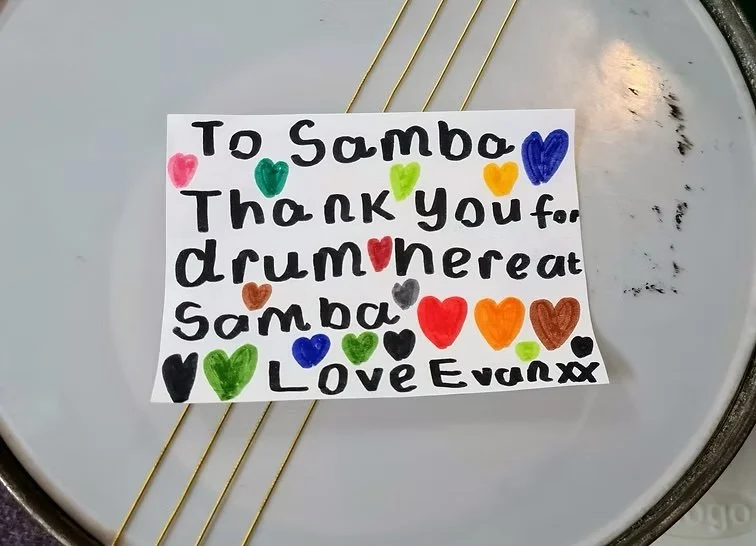
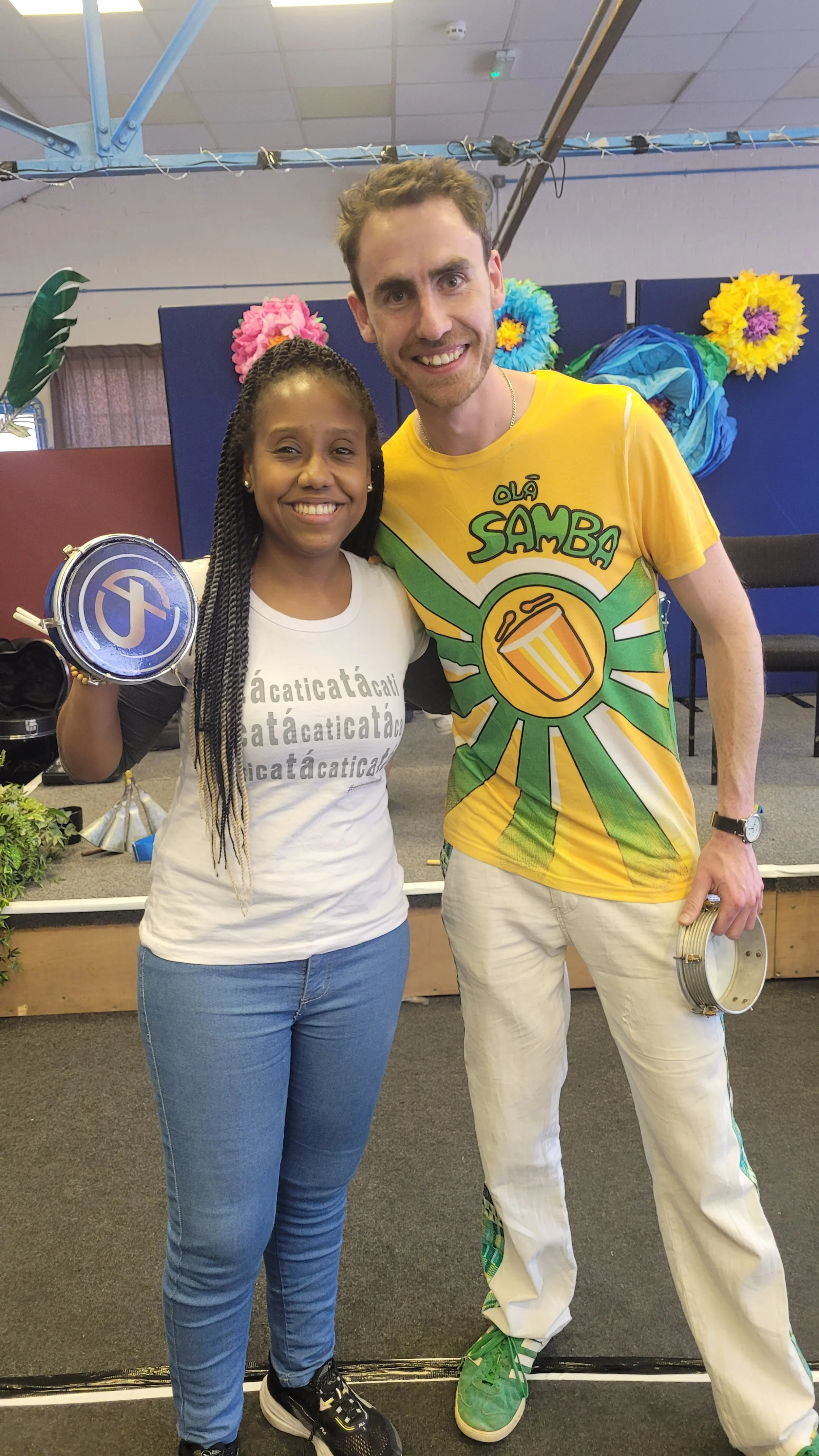
From one of my regular students at National Star College.
Back to Brazil
Since those early 2014-15 trips, Tan and I have returned to Brazil two more times (at the time of writing!). Especially thanks to my improved Portuguese I have forged my own links with the percussion community there and I feel increasingly connected with the culture.
We spent time in São Paulo, Salvador and Rio, and some other members of the OS Bateria joined in the fun in Rio too. It’s always an incredible time of learning, meeting some musical heroes and immersing ourselves in as much of the culture as we could. It’s always such a different proposition learning directly from these people in their home environment, rather than from videos online.
Some highlights from recent trips
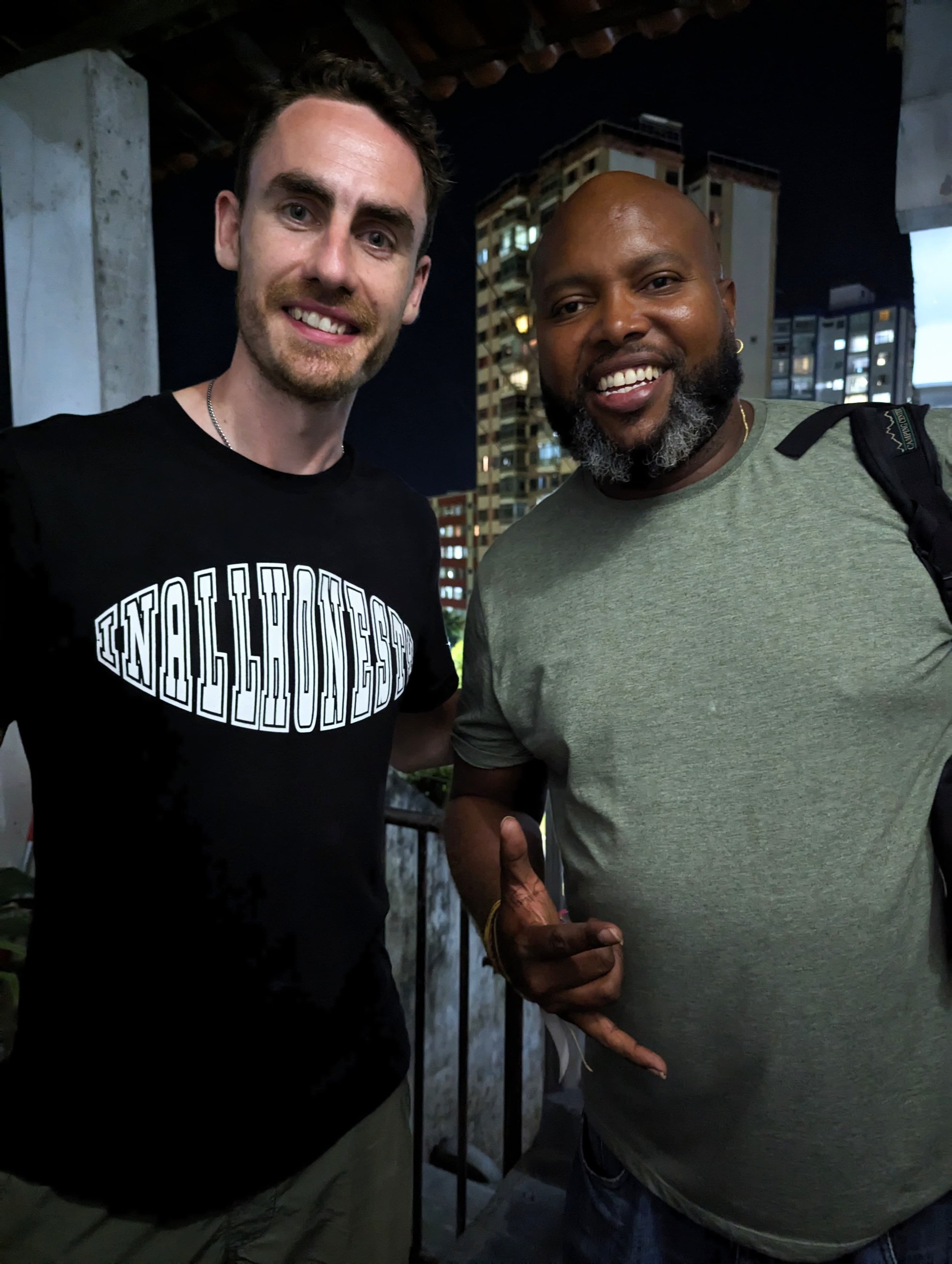
One highlight was meeting with Gilmário Marques, director from the world-famous Olodum. I recognised him on the street of the Pelourinho, we had a little chat and play on his busking setup, and he invited us the next day to a ‘communidade’ rehearsal project and to perform with his group Movimento Percussivo in front of the iconic Casa de Jorge Amado. What privilege to be a part of a rehearsal like this in the communidade, an area I would NEVER have gone to on my own. This was a project that speaks to the heart of what the music is about - bringing a sense of pride, ancestry and identity to those who have very little in a very unequal society.
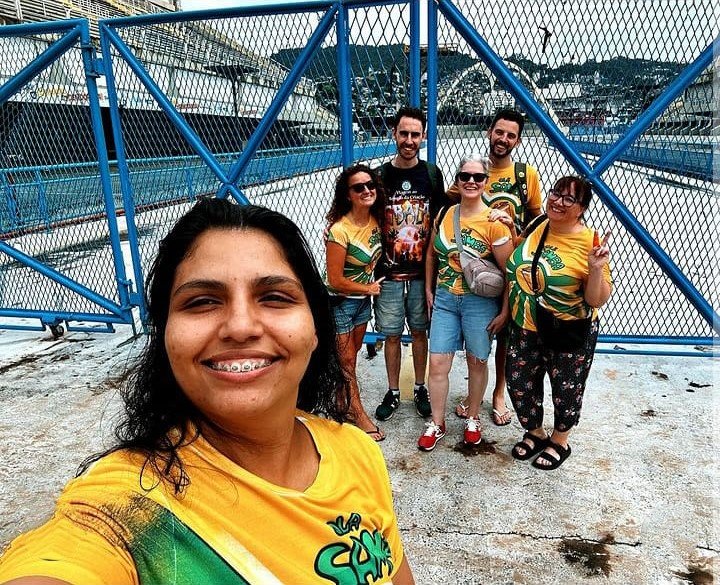
Another was learning directly with Thayane Catanhede, the chocalho director of Vila Isabel and founder of Vamos Chocalhar. Alongside the other members of OS Bateria on the same trip, she taught us her method of chocalho from the ground up, told of her history within the samba school scene, then showed us around her local neighbourhood and the Sambódromo. We later visited the infamous Cacique de Ramos with her, to play in their bloco rehearsal.
Yet another was to join the samba school Luz do Amanhã in their hometown of Jacareí near São Paulo. We made the extra trip to join them because one of their directors, Renan, had lived in Cheltenham for a while. It was such an honour for them to put on a special rehearsal to allow Tan and I to play with them while we were nearby. Since then, I have been learning and teaching material directly from the Luz do Amanhã bateria. It feels appropriate to learn from and make links with smaller, more local groups like this whom we are more akin to, rather than always looking to the juggernauts of the Rio Carnival Special Group.
And finally, learning about the music of candomblé in private lessons with Ney de Oxossi, André Gantois, Mayombe Masai, Antoine, and especially over 10 hours of lessons in Salvador with Everaldo. Everaldo was Jon Hardeman’s teacher (thank you, Jon, for putting us in touch). I was very sorry to hear of Everaldo’s passing in 2025. To really understand anything, you have to understand its roots. The carnival street music we love has its roots, in large part, in this religious music. This was such a valuable, rich time of learning that I will never forget.
Bora pra frente - Onwards!
Once you stop learning, you start dying. - Einstein
In 2022 I started studying Capoeira, the Brazilian martial art played to music, with Oficina da Capoeira. This has been an excellent way to immerse myself with another aspect of Brazilian culture and history, not to mention push my fitness. Through Capoeira I sing traditional songs, play the berimbau and speak Portuguese regularly with my Brazilian tutors. I was soon appointed Head of Music for Oficina da Capoeira in Europe.
In 2023 I started a Cheltenham-based roda de samba group, Samba de Lá, where I play cavaco/cavaquinho. Together, we study this side of Samba, singing classic sambas to percussion around a table.
Blog: What is Roda de Samba?
More recently, both Samba de Lá and the OS Bateria have collaborated with our counterparts in Bristol, especially Bloco B.
Many of my students have gone on to study in Brazil themselves, and some are taking regular online lessons from Brazilian teachers.
It is very rewarding to see my group and my students playing an active and important role in the furthering of Brazilian carnival arts in this country.
It’s a real privilege to have been able to keep Olá Samba as my full-time profession through to the present day - nearly 15 years later at the time of writing - and I have no intention of stopping! On top of my regular groups’ classes and performances I’ve mentioned in this post, my work takes me to all manner of one-off workshop bookings with schools and private groups, plus I work each week at the National Star College for students with special needs.
I’m still, and will always be, just scratching the surface of this culture. I will never stop learning and teaching. I will continue to take the opportunity to learn from a range of teachers wherever I can - shouldn’t we all!?
Why do I do it?
This music offers so much. So much more even than I could have imagined when I first started it.
The community that surrounds it has to be one of the main reasons. The community around regular groups becomes soon becomes your best friends, your support network and, in many ways, your family.
Playing music together is profoundly human. It’s real connection. Brazilian music is not the only example of this, but it’s one that resonates with me.
For me, the fact it’s an unexpected career path, going against the norm, living slightly at odds with the system, is something. It’s definitely not the sort of thing that would be suggested in a careers interview at school. It’s not working to make someone else more money. It’s not even working with the main goal of making money. In a world where the game can often be won when others lose, it feels more like winning by helping people win.
The Brazilian archetype of the Malandro - the samba-dancing figure dressed in white with a fedora, who is cunning enough to go it alone rather than work for the Man - is a big one in samba. My strange choice of go-it-alone career path starts to feel like I’m taking on aspects of this archetype (maybe aside from the trickster/knife-wielding element…). This definitely warrants a whole separate post!
Over to you!
Other courses and sessions that I have learned from along the way…
I wanted to include these partly to thank the tutors involved as I have gotten so much from the sessions, but also in case it might help you find some courses for yourself. Many of these courses are ongoing/recurring so do have a look into them.
Bloco Orixala day with Leon Patel organised by Mika de Oliveira at Art Brasil.
Percussion and Songs of the Orixas - residential course with Leon Patel, Holly Prest and Christian Weaver organised by Global Grooves
Brasil de Todos os Ritmos residential course with JPPercussion and Raz of One Voice Music.
Bata y Rumba residential course with Dave Pattman and Vicky Jassey of Bombo Productions and One Voice Music.
Just for Congas residential course with Raz of One Voice Music.
Rhythms of Candomblé day with Jon Hardeman, organised by myself and from which I developed our Bravum arrangement.
Thalita Santos and Gabriel Lopes Bossas Tour, plus another with Mestre Maurao, organised by JPPercussion.
Bloco X in Frankfurt
Mestre Mario Pam from bloco Ilê Aiyê, both in Salvador and visiting us here.
Mestre Nilo and Diretor Pablo from GRES Portela on their visit here
With the Olá Samba Bateria we joined the fun at Coburg Samba Festival, Germany - the biggest Brazilian music festival outside of Brazil, with hundreds of groups to see in a weekend. We also played at Percumon, Porto Segunto, Spain.
Our friends around the UK and around the world
Some other drumming groups to mention that I have played with and/or learned from along the way:
Afon Sistema in Bristol
Bloco Fogo in Kent (strangely these guys were rehearsing right under my nose in the town I grew up in, but I had no idea at the time!)
Ilu Axé in Bristol
Juba do Leão, Manchester
Paraiso in London
Samba Galez in Cardiff
Samba Masala and Sambiesta, Singapore
Samba Ya Bamba in Glasgow
There is a thriving Brazilian culture scene in the UK, most of which would come under the umbrella of Brazilian carnival arts. But it’s also worth noting that there are many Brazilian culture groups that are not under the umbrella of carnival arts groups! For example, Forró dance groups, capoeira groups, candomblé musical study groups, roda de samba groups...
The UK & Ireland Samba and Brazilian Carnival Hub Facebook Page contains a list of carnival groups, including samba schools and blocos.
And wherever you go around the world, you’ll find like-minded groups to join.
...Start your own story with one of them!