
Rhythms over Algorithms - The Importance of Community Music Today
In 2011, I wrote a dissertation for my Master's degree about the positive impact of community music. Back then, when I was playing with Bath Samba and Olá Samba was only an initial idea in my mind, community music felt to me like a great addition to life. Now, in 2026, after running Olá Samba for some 15 years, it seems that all those theories about the importance and positive impacts of community music are more true than ever.
These days, the news and geopolitics can be overwhelmingly negative, especially with the added engine of social media. We hear all too often about the increasing challenges of mental health, isolation, and division. On top of this, more recently, we are standing on the precipice of societal change at the hands of artificial intelligence. While we do not know how large and how far-reaching this change will be, AI is already replacing and transforming many people's jobs, including those in the creative arts.
At a time when even our creativity seems to be outsourced to computers, I think it's even more important to remind ourselves of purely analogue, purely face-to-face, purely human interaction. This is where community music groups excel.
When I say community music groups, of course, I'm thinking of my own percussion groups first and foremost. But we can also think of orchestras, choirs, and even dance groups. We could even think more broadly to include other creative outlets like writing and art groups.
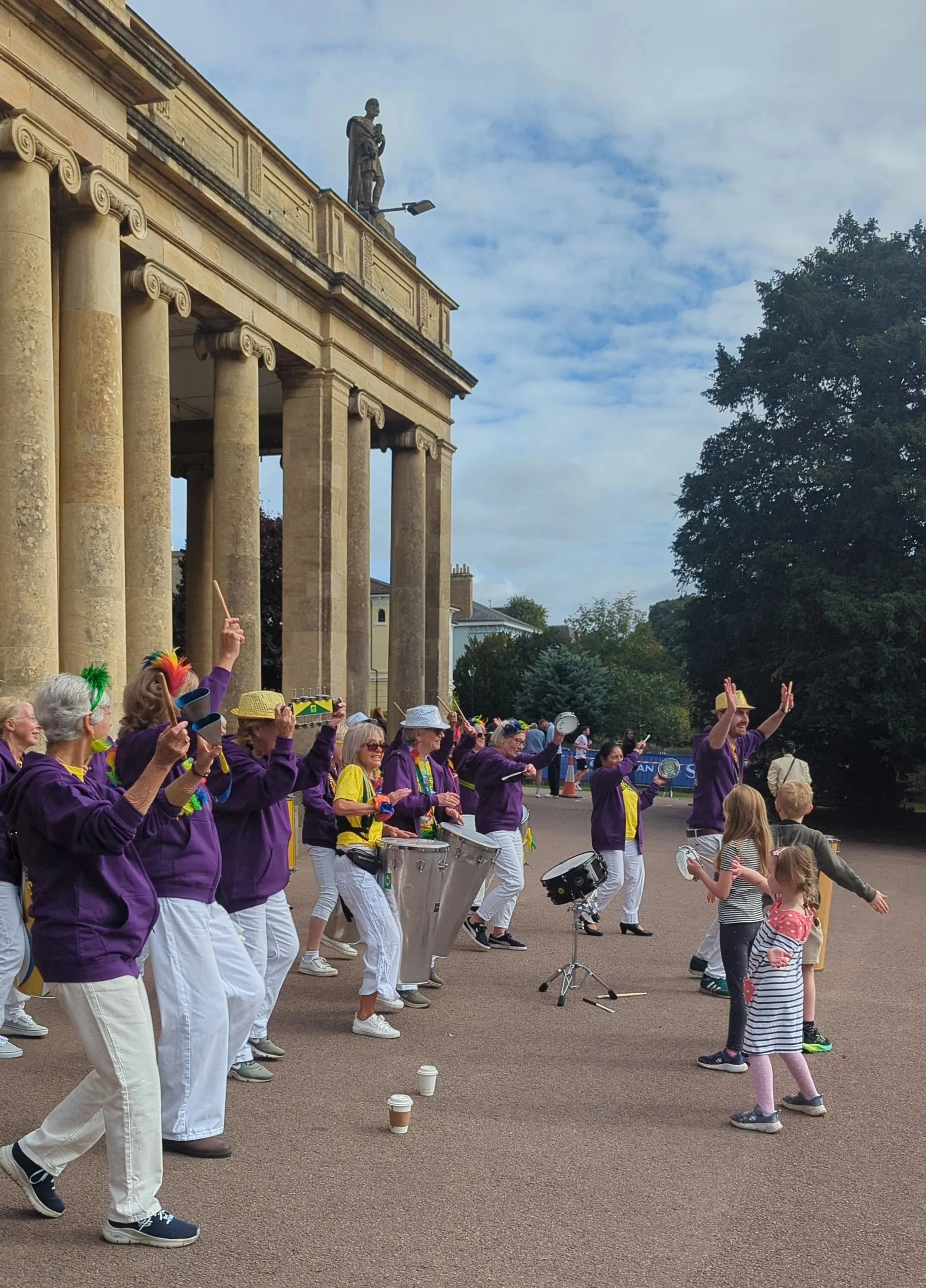
The Silver Sambistas in front of the old stone of the Pittville Pump Rooms, Cheltenham, with the next generation joining in.
Social
Members of these groups get a weekly check-in time with close friends and acquaintances. There’s a chance to catch up in the break and at socials. These groups provide an important ‘third space’ outside of home and work where people can feel like they belong.
It's an increasingly rare time to interact in person without screens. It's a time to be working towards a collective goal in the same physical space—a goal which is not driven by money or pay-per-click, only positivity. It's a time to create something together through physical movement and dexterity, without a keyboard, mouse, or algorithm.
More than this, screens tend to funnel us into groups of people with similar viewpoints and lifestyles. Whether it's an email list from a political party, a Facebook group, or a YouTube channel, digital spaces tend to attract like-minded people and become more specialised over time. We are increasingly aware of how important it is to break out of our own ‘echo chambers’ for balance.
It used to be that going down to the local pub or to a regular place of worship would be a time and place for people from all walks of life within a community to rub shoulders and talk things through. With pubs going out of business and churches seeing lower attendance, where else can we engage with other parts of our own community? A community group like ours welcomes people from all backgrounds, faiths, and statuses on a level playing field, with as low a financial barrier to entry as possible. A weekly class costs about the same as a pint!
Present
It’s also a time to be grounded in the present. We often hear of the importance of finding your flow state—to be ‘in the zone’ and undistracted. In the case of music groups, that ‘present’ moment really means present. In percussion, playing a note tiny fractions of a second earlier or later is the difference between it sounding excellent or sounding horrible. It takes full attention and deep focus to be done well.
Apply this to performances, where not only are you doing your thing but actively engaging with an audience, and the present moment becomes so all-consuming there’s no way you can be distracted by anything in the outside world. I distinctly remember moments in past performances where I saw the movement of the band and audience together in slow motion, transcending individuality. Negativity feels far away in these golden moments.
Bringing you truly into the present, away from ‘monkey chatter’ and anxiety, this practice becomes a form of active meditation and mindfulness.
Human
In the age of the rise of machine intelligence and robotics, it’s hard to imagine something more human than coming together to play music. It harks back to singing around the fire, conversation, stories, and dance as we gather at the end of the day.
More than this, a lot of what we learn in these groups is the human context of these rhythms. We spend time learning and understanding where the music came from—thousands of miles away in a completely different culture. We learn it and pass it on to the next generation by speaking and listening. Then we think about how we're going to perform it and to whom—often to locals who have never seen the style before. We are part of the living lineage of the art form, exploring how this culture finds its place within our own evolving society.
This is all without even mentioning the raw physicality of the music, whether it’s the power and impact of hitting a drum, or the visceral vibrations of singing. Give someone a big drum to hit and they can feel the vibrations in their bones, sending them through the air and into the eardrums of the audience to make them move. No filter!
As our lives become increasingly digitised and machine-oriented, let's make sure our hobbies remain stubbornly off-the-wall and human. So turn this off and join in!
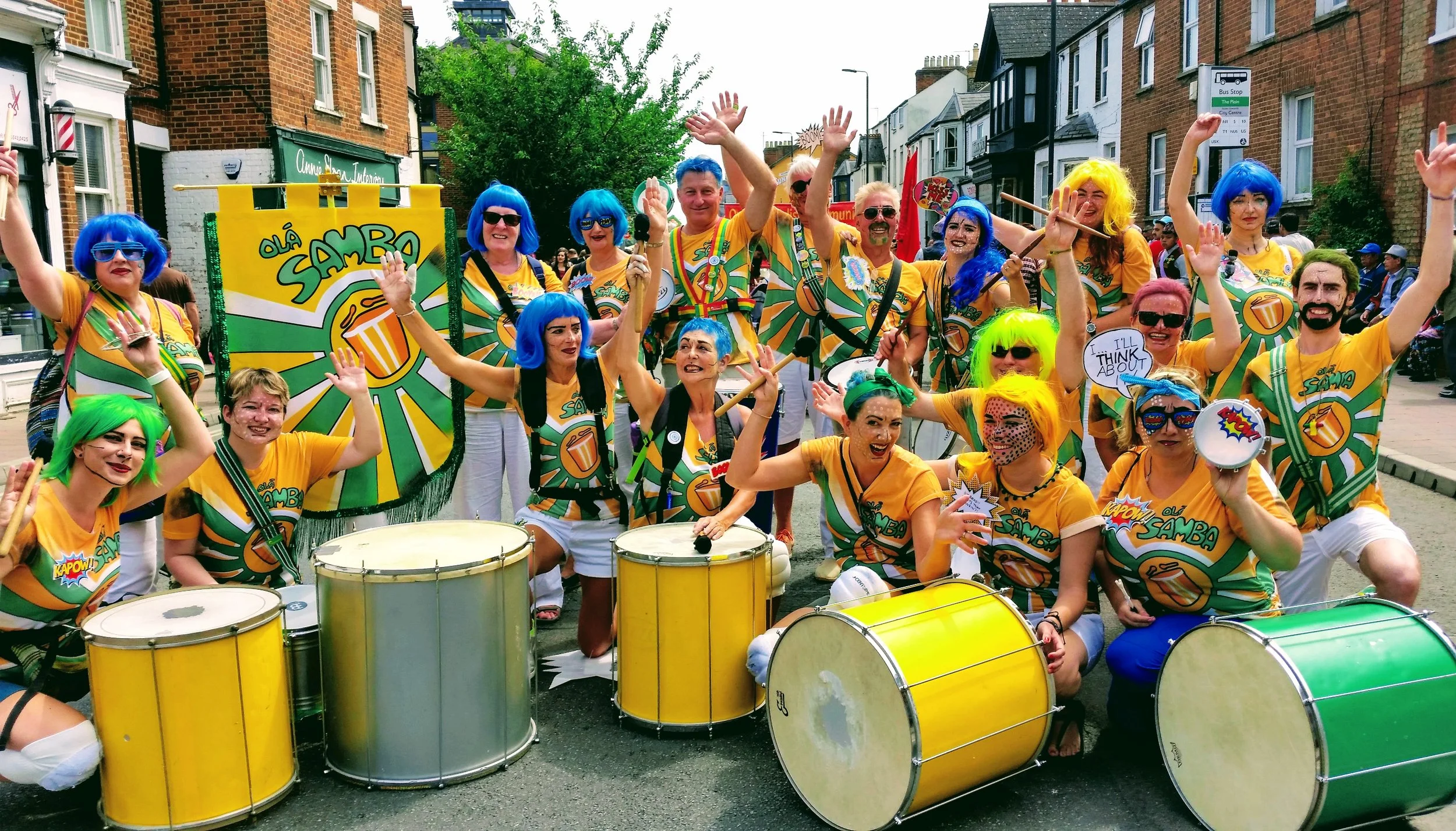
The Olá Samba Bateria at Cowley Road Carnival 2018